Holidays are a time that lets us rest, relax the mind and enjoy our time as much as possible, and part of that enjoyment comes from sharing time and pleasant activities with family, friends and (obviously) with our dogs. However, going back to the daily routine, in which most of our day to day is taken up with other tasks, is a process that tends to stress us and requires time for us to adjust again.
To understand your dog's post-holiday stress, think about the time and stress it takes your mind to switch the chip back to "routine life" mode, even knowing in advance that that day and moment will come and knowing the reasons why you have to do it. Have you got your head around it? Good, now apply that same stress to your dog, and consider that on top of that he does not understand the need for that change nor did he expect it to happen, instead it was completely sudden for him.
From one day to the next you stop sharing time, walks and play with him. And very often, when going back to daily life, your dog has to stay home alone while you work. That abrupt change in routine, without understanding or foreseeing it, combined with loneliness, means dogs can suffer post-holiday stress, even more serious than that of humans, with many becoming severely depressed, showing symptoms such as the ones we will list below:
Loss of appetite and apathy
One of the classic symptoms of stress is loss of appetite. Whether due to depression and distress, or to defiance, it is possible that your dog will not want to eat the amount of food he needs. This may be accompanied by listlessness and lack of reaction (or a lack of desire to do physical activity) due to the reluctance brought on by the abrupt change to a routine in which he can no longer play or go for walks as much.
Loss of hygiene habits
It is very common for a dog who experiences sudden (and especially unpleasant) changes to rebel by starting to urinate and defecate in different spots around the house, even though he was previously used to doing it in the street or the yard. This can be understood as a sign of displeasure with the situation, but it is also possible that he has lost his routine habits and schedules during the holidays. The solution is not to scold him for his behaviour, but rather to try to recover the routine of walks and encourage him to relieve himself there.
Hyperactivity
Not all symptoms are signs of depression. Another of the most common signs is hyperactivity, which can occur the moment you leave the house, especially for long periods of time (such as going to work). When you return you may find a mess in your home, but it is not advisable to scold him. As in the previous point, the best thing is to gradually resume your routine and leave him alone for longer and longer until you reach the amount of time you would normally be away in your usual life.

“Changes in routine affect your dog too. A little planning makes the return to normality much easier on them.”
Hair loss and muscle stiffness
These two physical symptoms are not exclusive to stress; they can indicate a great many ailments and illnesses. However, they are also characteristic of a state of chronic stress, in which your dog feels extremely unsettled due to the discomfort he feels from the change of routine.
Excessive and violent reactions
Finally, another possible symptom of stress and depression is an excessive and even aggressive reaction to different stimuli. This can range from noises or the presence of other animals to even when you try to pet him. If your dog behaves reluctantly towards you you must never respond in a violent or aggressive way with him, as you could worsen his bad temper and make the situation worse.
How to prevent your dog from suffering post-holiday stress?
The most suitable way to prevent your dog from suffering post-holiday stress is to keep a routine similar to the one you would have in your daily life during the holiday period. This does not mean you have to do everything exactly as in your day to day, but rather that you specifically respect your dog's walks, their duration, and the time you spend with him as if it were just another day.
Visit Clínica Veterinaria SOMO to check your dog's health
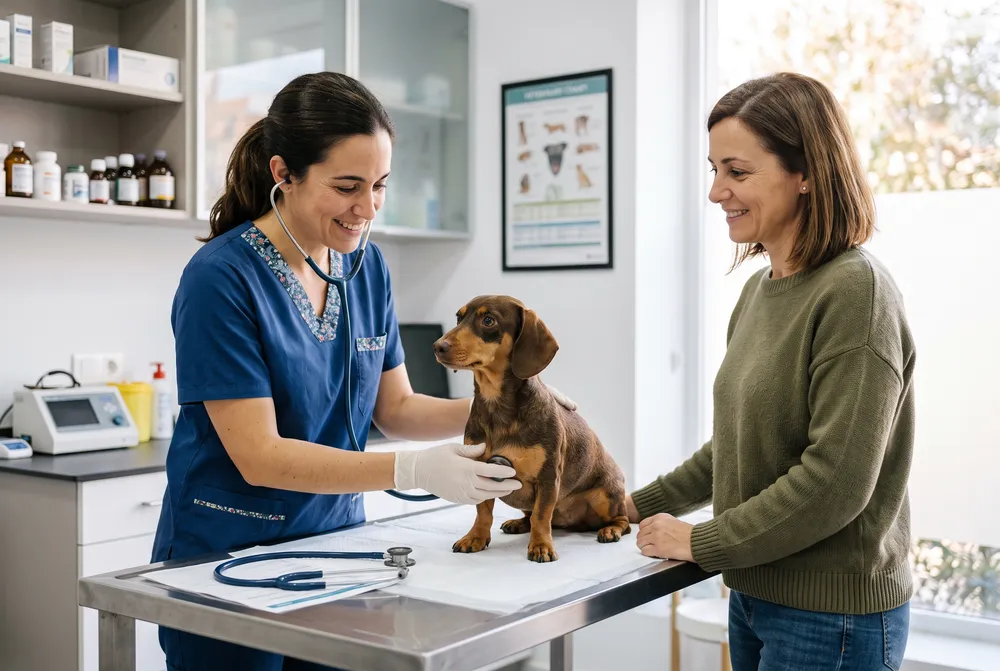
Before assuming that the cause of your dog's discomfort is post-holiday stress, it is necessary to give him a complete check-up. To rule out any ailment, we invite you to come to Clínica Veterinaria SOMO in Cantabria, so you can know for certain that his condition is due to psychological causes and consult our specialists on how to proceed to improve your dog's mental health.
Frequently asked questions
What are the symptoms of post-holiday stress in dogs?
The most common signs include loss of appetite and apathy, loss of hygiene habits, hyperactivity, hair loss and muscle stiffness, and excessive or aggressive reactions to different stimuli.
How can I prevent my dog's post-holiday stress?
The best approach is to keep a routine during the holidays similar to your daily life, respecting walks, their duration and the time you spend together, so that the return to routine is not so abrupt.
Should I scold my dog if he urinates indoors or breaks things?
No. With both loss of hygiene habits and hyperactivity, it is advisable not to scold him, to gradually resume the walking routine and to leave him alone for longer and longer until you reach the time you would normally be away.